
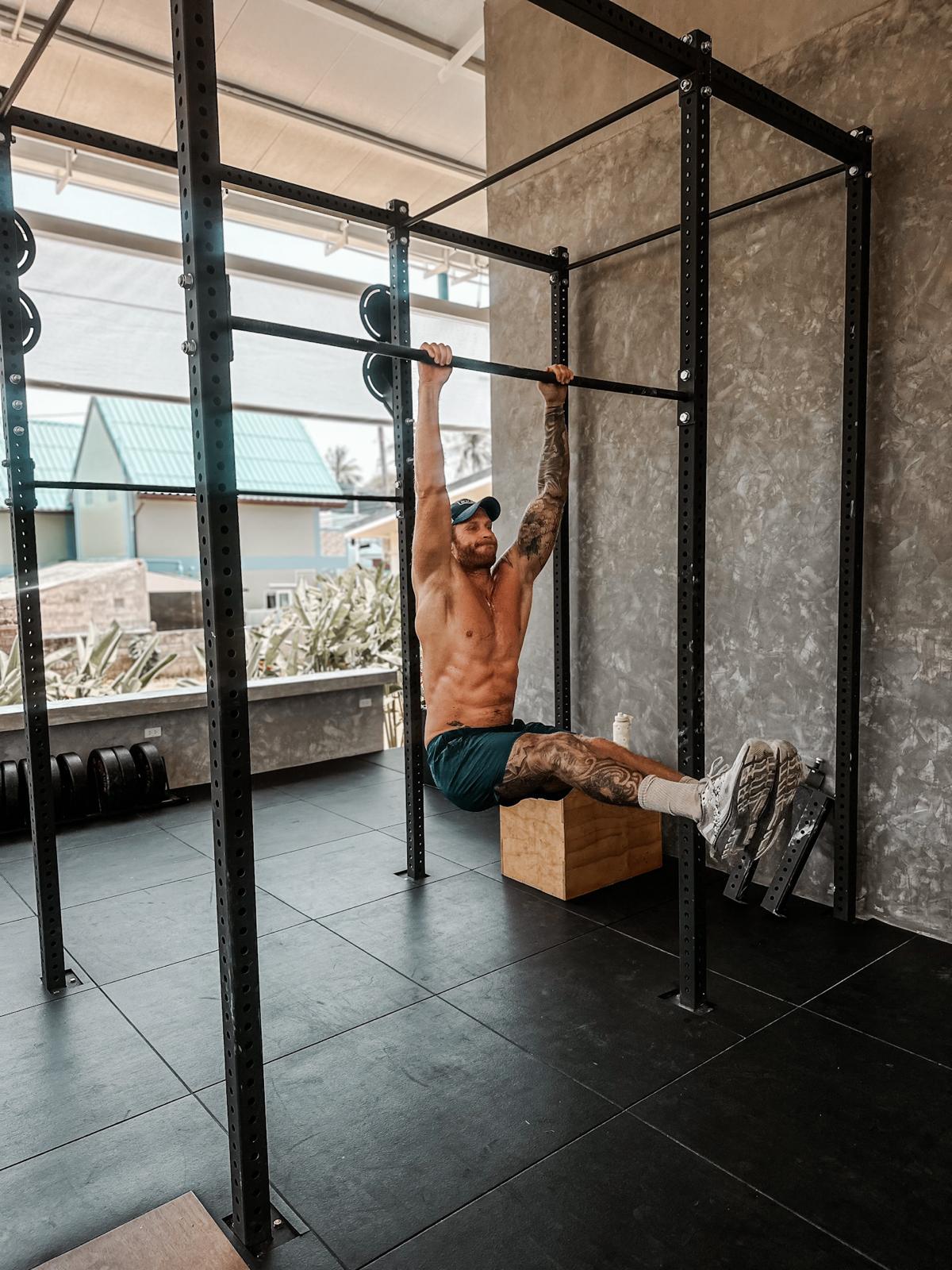
Bodyweight Training: The Complete Guide to Getting Strong
Bodyweight training is a form of resistance training that uses your own body as the primary source of resistance. When it is programmed with progressive overload, adequate recovery and consistency, bodyweight training can improve strength, muscle development, mobility, coordination and overall fitness.
And despite what the fitness industry often tells you, you don’t need a commercial gym to get started.
You need a body, a plan and a reason to keep showing up.
What Is Bodyweight Training?
Bodyweight training is exactly what it sounds like: using your own bodyweight as resistance during exercise.
Some of the most effective examples include:
Push-ups
Pull-ups
Squats
Lunges
Split squats
Dips
Planks
Mountain climbers
Handstand variations
Pistol squats
Burpees
But bodyweight training is much more than putting together a random collection of exercises.
The real value comes from understanding how to manipulate movement, resistance, volume, tempo, range of motion and difficulty to continually challenge your body.
That’s where good programming separates itself from simply doing workouts.
Does Bodyweight Training Actually Build Muscle?
Yes.
This is one of the biggest questions people ask.
If you’ve spent years being told that muscle requires heavy barbells and expensive gym equipment, it can be difficult to believe that your own body can provide enough resistance.
But your muscles respond to tension and training stimulus, not to the logo on the equipment.
A beginner might find a standard push-up extremely challenging.
As they become stronger, they can progress to:
Decline push-ups
Diamond push-ups
Deficit push-ups
Archer push-ups
Ring push-ups
Handstand push-up progressions
The exercise becomes harder as the person becomes stronger.
That’s progressive overload.
And progressive overload is one of the fundamental principles of building strength and muscle.
The American College of Sports Medicine’s 2026 resistance-training guidance specifically notes that bodyweight exercises and home-based training can produce meaningful improvements in strength, hypertrophy and physical function.
So no, bodyweight training isn’t simply “beginner training.”
It can become incredibly advanced.
The 7 Fundamental Movement Patterns
Rather than thinking about individual muscles, I prefer to think about movement patterns.
A well-designed functional training program should cover the major ways your body needs to move.
1. Squat
Examples include:
Bodyweight squats
Split squats
Bulgarian split squats
Pistol squat progressions
These develop lower-body strength while challenging balance and control.
2. Hinge
Examples include:
Single-leg hip hinges
Glute bridges
Hip thrusts
A hinge teaches you how to generate force through your hips while controlling your spine.
3. Push
Examples include:
Push-ups
Pike push-ups
Dips
Handstand push-up progressions
4. Pull
Examples include:
Pull-ups
Chin-ups
Inverted rows
Towel or band rows
A pull-up bar can dramatically expand what is possible with bodyweight training.
5. Lunge
Examples include:
Reverse lunges
Walking lunges
Lateral lunges
Bulgarian split squats
Single-leg movements are particularly valuable because they challenge strength, stability and coordination simultaneously.
6. Carry
Carries are often overlooked in bodyweight programs because they usually require an external load.
But adding a kettlebell, dumbbell or even a heavy object can transform a simple bodyweight program into a highly functional training system.
7. Brace and Rotate
Your core isn’t just a six-pack.
Your trunk transfers force between your upper and lower body and helps you control movement.
Exercises such as planks, side planks, dead bugs and controlled rotational movements can develop this foundation.
Bodyweight Training Isn’t About Doing Endless Reps
This is where many people get bodyweight training wrong.
They assume that if an exercise becomes easy, the only solution is to do more repetitions.
That’s not always the best answer.
If you can comfortably perform 40 bodyweight squats, doing 100 more isn’t necessarily the smartest way to continue progressing.
Instead, change the challenge.
You can:
Increase the range of motion
Slow the eccentric phase
Add pauses
Move to a unilateral variation
Increase leverage demands
Add external resistance
Reduce assistance
Increase the quality of each repetition
The goal isn’t simply to accumulate fatigue.
The goal is to create a training stimulus that your body has to adapt to.
How Do You Progress With Bodyweight Training?
Progression is what turns exercise into training.
Without progression, you’re simply repeating activity.
There are several ways to progress a bodyweight exercise.
Increase Repetitions
If you can perform 8 quality push-ups today, work toward 10, then 12.
Improve Technique
A technically perfect repetition is very different from a rushed repetition with poor range of motion.
Increase Range of Motion
A deeper squat or deficit push-up can significantly change the challenge.
Change the Exercise
Move from a standard exercise to a more difficult variation.
Add External Resistance
Eventually, adding a kettlebell, weight vest or other resistance can make progression easier.
This is one reason I don’t believe bodyweight training and equipment-based training need to be opposing philosophies.
Use the minimum equipment necessary to achieve the result.
Is Bodyweight Training Good for Beginners?
Absolutely.
In fact, one of its biggest advantages is scalability.
A beginner can start with:
Incline push-ups
Assisted squats
Reverse lunges
Elevated rows
Planks
Then progressively move toward more demanding variations.
The important thing is not starting with the hardest exercise.
It’s starting with the exercise that is challenging enough to create progress while still allowing you to perform it safely and with control.
Is Bodyweight Training Good for People Over 40?
It can be an excellent option.
As you get older, the goal of training shouldn’t simply be lifting the heaviest weight possible.
You want to maintain strength while also preserving:
Mobility
Balance
Coordination
Muscle mass
Cardiovascular fitness
Movement quality
That is one of the reasons I like functional training so much.
You’re not just training a muscle.
You’re training your ability to move.
And maintaining the ability to move well is one of the most valuable things you can do for long-term independence.
The WHO recommends that adults perform muscle-strengthening activities involving the major muscle groups on at least two days each week, alongside regular aerobic physical activity.
Bodyweight training can be one practical way to achieve that resistance-training component.
How Often Should You Do Bodyweight Training?
There isn’t one perfect number.
Your ideal frequency depends on your training age, goals, recovery, schedule and the intensity of your sessions.
For many people, three to four structured sessions per week is an excellent starting point.
You can then combine strength-focused sessions with walking, running, cycling, sport or other forms of cardiovascular activity.
The bigger principle is consistency.
The latest ACSM resistance-training guidance reinforces this idea: the biggest jump in results often comes from moving from no resistance training to doing some resistance training consistently.
That’s something I’ve believed for years.
The best program isn’t the one that looks most impressive on paper.
It’s the one you can actually follow.
Bodyweight Training vs Gym Training
This shouldn’t be an either/or argument.
Both can work.
A commercial gym gives you access to more equipment and makes it easier to load certain movements progressively.
Bodyweight training gives you freedom.
You can train:
At home
In a hotel
Outdoors
While traveling
With very little equipment
For busy people, that convenience can be incredibly powerful. That’s exactly why I built Bodyweight Built around minimal equipment rather than expensive gym machines.
If removing the commute to the gym means you can train consistently three times a week instead of occasionally making it to the gym, bodyweight training may actually produce better results for you.
That’s why I believe simplicity is a performance advantage.
The Biggest Mistakes People Make With Bodyweight Training
Doing Random Workouts
A different workout every day might feel productive, but it can make progression difficult to measure.
Never Progressing
If the exercises, repetitions and difficulty never change, your body has less reason to adapt.
Chasing Soreness
Being sore isn’t the same as making progress.
Ignoring Recovery
Training is the stimulus.
Recovery is where adaptation happens.
Making Training Too Complicated
You don’t need 27 exercises in a session.
Master the fundamentals first.
What Equipment Do You Actually Need?
Technically, you need nothing.
That’s the beauty of bodyweight training.
But if you want to expand your options, I’d recommend starting with:
1. A pull-up bar
This opens up a huge range of pulling and upper-body exercises.
2. A kettlebell
One kettlebell adds resistance for squats, hinges, presses, rows, carries and conditioning.
3. Resistance bands
Bands are inexpensive, portable and useful for both strength work and mobility.
That’s enough for an incredibly versatile home training setup.
You don’t need a room full of machines.
Frequently Asked Questions
Can bodyweight training build muscle?
Yes. Bodyweight exercises can build muscle when they provide a sufficient training stimulus and are progressed over time. Nutrition, sleep and recovery also play important roles.
Is bodyweight training enough to get fit?
For many people, yes. A well-designed program can develop strength, muscular endurance, mobility and conditioning. It can also be combined with walking, running, cycling or sport to develop broader fitness.
Can you get strong with bodyweight exercises?
Absolutely. Advanced bodyweight movements such as pull-ups, single-leg squats and handstand push-up progressions can require substantial levels of relative strength.
How many bodyweight exercises should I do per workout?
There is no magic number. A focused session using several well-chosen movement patterns is generally more useful than trying to cram as many exercises as possible into one workout.
Is bodyweight training good for women?
Yes. Bodyweight training is suitable for both men and women. The appropriate exercises, resistance and progression should simply be matched to the individual’s current ability and goals.
Can you do bodyweight training every day?
You can move every day, but that doesn’t mean every day should be a hard strength session. Recovery should be considered when planning training frequency and intensity.
Key Takeaways
Bodyweight training is legitimate resistance training.
You can build strength and muscle without a commercial gym.
Progressive overload is the key to continued improvement.
Training movement patterns creates a more functional approach to fitness.
Bodyweight training can be scaled from complete beginner to highly advanced.
A pull-up bar and kettlebell can dramatically expand your options.
Consistency matters more than complexity.
Your training should support your life rather than take it over.
My Approach to Bodyweight Training
I’ve spent more than two decades training and coaching, and one of the biggest lessons I’ve learned is that fitness doesn’t need to be complicated to be effective.
In fact, I think we’ve made it far too complicated.
The goal isn’t to collect exercises.
The goal is to build a body that is strong, capable, mobile and resilient.
That’s why my approach focuses on fundamental movements, progressive training and programs that fit around real life.
If you want to understand more about how I approach training and coaching, you can learn more about my coaching philosophy on my Meet Matt page.
And if you want structured workouts that take this philosophy and turn it into a program you can actually follow, cheque out Bodyweight Built.
Because ultimately, the best training system isn’t the one with the most exercises.
It’s the one that helps you become stronger-and keeps you training consistently enough for those results to compound.
Final Thought
You don’t need to train like an athlete to become more athletic.
You don’t need a commercial gym to become strong.
And you certainly don’t need to make fitness complicated to make it effective.
Start with your body.
Master the fundamentals.
Progress intelligently.
Then build from there.
That’s bodyweight training done properly.
0 Comments